

Make the status visible to the next person

Software shaped to the way you work.

When a spreadsheet or a chain of email handoffs holds the work up, a focused application may help. We define the first useful version and compare it with the tools you could already use.

We reply within one business day. Use the contact form to request a conversation about your work.

Painted software planning table with paper screens, modular request cards and drawing tools
A useful tool starts with the work around it.Toledo & Detroit Metro

The work behind the request

Someone always has to ask where the work stands.

A request appears complete in the spreadsheet, but the supporting email contains a change. Someone updates their own copy, another person asks for the latest file, and the next task waits. The cost sits in all the small conversations needed to reconstruct what should have been visible in the record.

A focused application can give the process a shared place to live. We work through what each person needs to see, what they may change and which decision allows work to continue. That detail determines whether a custom tool earns its maintenance cost or whether your current software needs a better setup.

Illustrative workflow

Give a request a record your team can trust.

A clearer process, with a place for review.

Illustrative workflow: an internal team tracks requests that need review before work begins. The proposed screens below describe a possible first release, not an existing client application.

  1. 1Request record
    Ready for review

    Collect what the next person needs.

    Give the requester a form with the fields required for review. Preserve a draft if the information is incomplete and make the missing details clear before submission.

  2. 2Role and access
    Assigned reviewer

    Let each person act within their role.

    The requester can see their submission; the assigned reviewer can make the approval decision. Agree who may reassign work or see records outside their own team.

  3. 3Status change
    Decision recorded

    Explain what moved and why.

    A status change records the responsible person and relevant note. A returned request tells its owner what to fix, so another email thread is not needed to interpret it.

  4. 4Next action
    Handoff checked

    Keep failures attached to the work.

    If an approved request must reach another system, show whether that handoff succeeded. A failed update needs a way to recover and someone responsible for checking it before trying again.

What this makes possible

The first release should let the agreed roles complete a real request and resolve an incomplete one. Your team can then judge whether fewer status checks and duplicate entries justify expanding the application.

Where this helps

Start with work you recognize.

We build a focused web application or internal tool around a defined business process. We first check whether an existing product can do the job, then agree on the screens, permissions and connections a custom build would need.

For teams coordinating work through spreadsheets, email threads and workarounds that their current software cannot support.

Illustrative workflows, scoped to your tools and team.

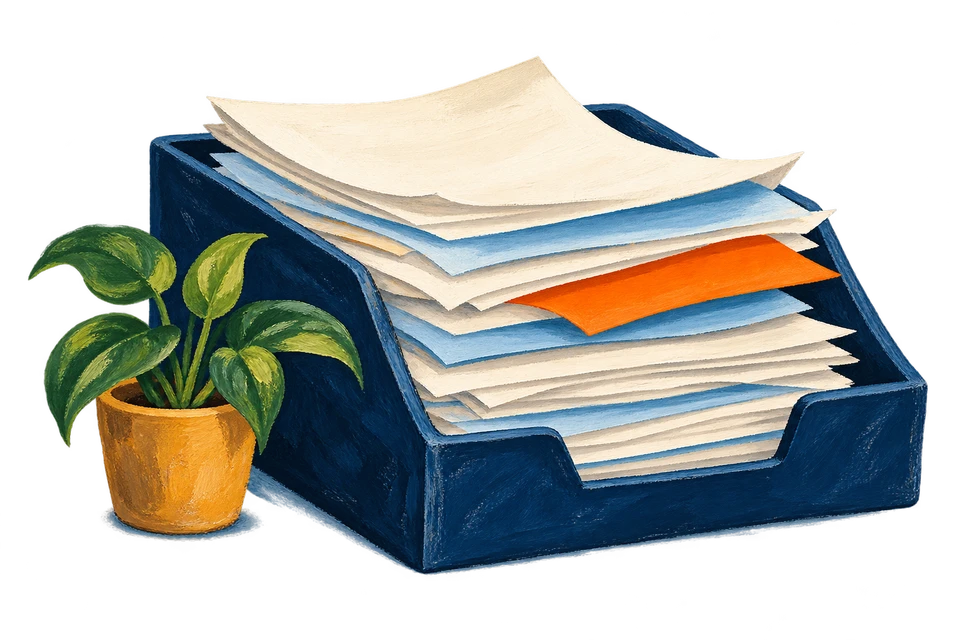
Painted stack of request papers in a navy tray beside a small plant

Use case 01

Give requests a shared home

Today
Requests arrive in several places and their status depends on who last replied.
With help
A proposed application gives each request an owner, a status and a visible next step.
People’s role
Your team approves the access rules and decides which changes need a second person.

Painted approval clipboard with an orange check and pencil

Use case 02

Replace a spreadsheet handoff

Today
People maintain copies of a spreadsheet and reconcile changes before work can continue.
With help
A shared interface can collect the required information and keep a record of updates.
People’s role
The process owner checks calculations, permissions and the handling of incomplete entries.
Painted navy laptop with a simple internal-tool screen beside a cream mug

Use case 03

Connect an internal process

Today
An approved request still has to be entered into a second tool by hand.
With help
A scoped integration can pass the agreed fields into the next system and show whether it succeeded.
People’s role
Failed or conflicting updates go to an owner who can retry or correct them.

A boundary for the first release

Define who can move a request forward.

These decisions influence what we build, how you test it and what it costs to keep running.

First release plan

  1. 1

    The smallest complete task

    Choose a request that can move all the way through the process, including a return for missing information.

  2. 2

    Rules for the less straightforward cases

    Define duplicate submissions, reassignment and permissions before they become confusing behavior in a finished screen.

  3. 3

    A release your team can operate

    Agree how records are checked, which existing information is needed and how people will start using the tool.

Make the economics work

Fewer status checks can lower coordination costs.

Reducing wasted time may improve your margin when you avoid an expense or take on additional paid work. Count the cost of review, corrections, software and upkeep before deciding whether the change pays for itself.

Where time goes (and comes back)

  1. A visible next stepPeople can see whether a request needs information, a decision or further work before asking someone to explain its status.
  2. Fewer conflicting copiesA shared record can reduce reconciliation work when the access rules and update history match how the team operates.
  3. Less coordination overheadTime spent chasing progress is a cost of serving each request. Reducing that effort may create capacity, provided the application stays affordable to run.

Put a number to your own workflow.

Use the calculator to compare the time recovered with the cost of running the workflow. Savings depend on your process.

Estimate my return

A useful starting point

When this makes sense.

  • A specific process is slowing down and the people using it can explain why.
  • You can identify the first version that would be useful.
  • An owner can make decisions during the build and run the application afterward.

Before committing

Sort this out first.

  • An existing feature or product already meets the requirement at a sensible cost.
  • The project needs an agreed owner or a clearer first release before a build can be scoped.

Your existing tools

Keep what already works.

Each connection is scoped against the receiving system's actual capabilities. A connection may use an API or an approved import and export process, depending on the access available.

  • Existing records and approved business systems
  • Account roles and permission boundaries
  • Visible failure handling and a documented recovery path
Compare my build and buy options
Painted navy handoff notebook with an orange bookmark, a key and pencil

What your team takes forward

Know who can change the application.

The proposal should spell out source access, hosting accounts and responsibility for updates. We also define how a requested change will be assessed, because a useful first release needs a practical way to stay useful as the process changes.

See my project path

A handoff you can use.

  • A written scope covering users, screens, permissions and acceptance checks.
  • The agreed application and documented integration boundaries.
  • A release plan with checks for the critical tasks your team performs.
  • Agreed source materials, deployment notes and instructions for maintenance.

Keep exploring

A little reading before the call.

Before we talk

Questions worth asking.

For anything specific to your tools or team, bring it to the conversation.

Request a call
How do we decide whether to build or buy?

Start with the task, the people doing it and the requirements that existing tools cannot meet. Compare the cost of a custom build and its upkeep with the compromises and fees of an available product.

What will we own after the project?

The proposal should name the source materials, accounts and documentation included in the handoff, along with any third-party licenses. We agree those boundaries before work begins.

Can we start with a small version?

Yes. We can scope a first release around a limited set of users and one useful process, with additional features considered after your team has tried it.

Toledo & Detroit Metro

Bring the spreadsheet everyone has a copy of.

Walk us through a request that required extra chasing or re-entry. We can use that example to discuss the missing capability and whether a focused application is worth scoping.

Request a call

We follow up to arrange a time. Your form does not book an appointment automatically.

Painted Great Lakes shoreline with a sailboat and a neighborhood beyond the water

A clearer next step, together.